Share

Natural vs Synthetic Perfumes: What's Better for You?
Share
Natural perfume ingredients are extracted directly from plants and resins and tend to smell rich but fade quickly, while synthetic aroma molecules are lab-created to be more stable, consistent, and longer-lasting on skin. Most fine fragrances, including luxury ones, use a blend of both rather than choosing one exclusively.
What "Natural" Actually Means
Natural fragrance materials come from flowers, leaves, roots, and resins through extraction methods like steam distillation or cold pressing. They offer genuine complexity and a soft, organic character. The tradeoff is volatility: natural ingredients evaporate faster than synthetic ones, and because they're agricultural products, the exact scent of a natural rose or jasmine extract can vary from harvest to harvest.
What "Synthetic" Actually Means
In fine perfumery, synthetic doesn't mean cheap — it means engineered. Lab-created aroma molecules let perfumers achieve effects that don't exist in nature, and they solve two real problems: they act as fixatives that help a fragrance last significantly longer on skin, and they let brands avoid animal-derived ingredients like natural musk or ambergris by replicating the scent synthetically instead.
Which One Lasts Longer?
Synthetic molecules generally win on longevity. They're more chemically stable than natural extracts, which is why fragrances built for all-day wear typically combine natural oils for character with synthetic fixatives for hold. A perfume made purely from natural extracts, however luxurious it smells at first spray, will usually fade faster than one built with synthetic anchors in the base.
Is One More "Luxurious" Than the Other?
Not inherently. The idea that natural automatically means higher quality is a common misconception — a poorly blended natural fragrance can smell thin and disappear in an hour, while a well-formulated blend of natural and synthetic elements can be both complex and long-lasting. Quality comes down to sourcing and blending skill, not which category an ingredient falls into.
How Nizzz Approaches This
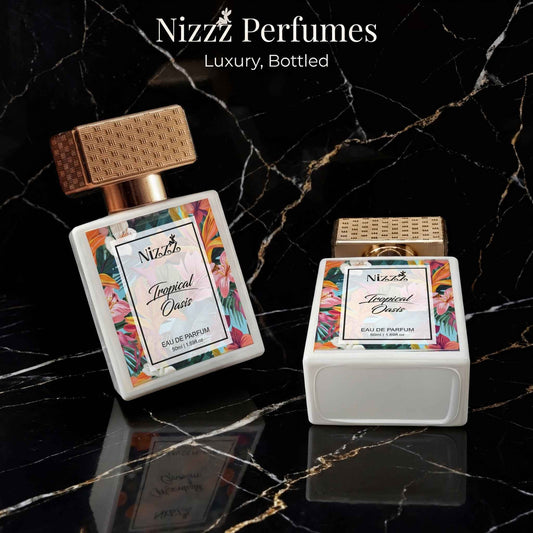
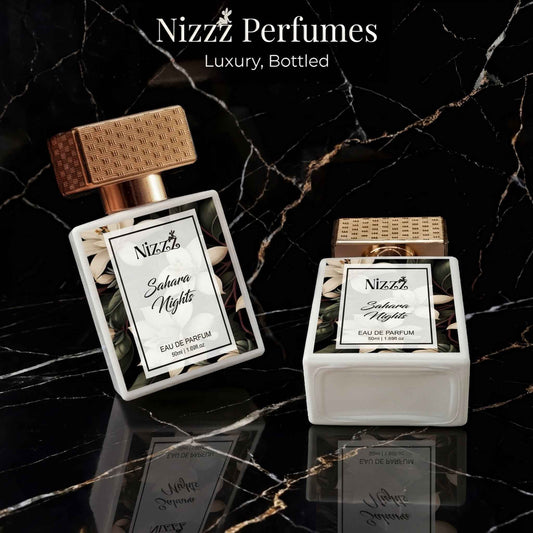
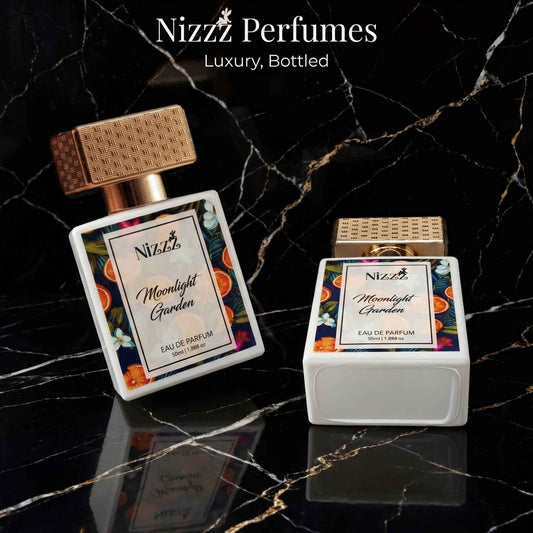
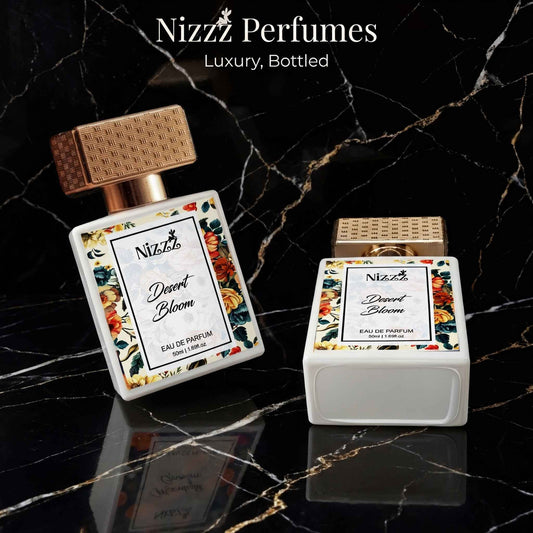
Our four fragrances use natural oils for the heart notes — rose and jasmine in Desert Bloom, citrus and bergamot in Moonlight Garden — paired with modern aroma molecules in the base to extend how long each scent lasts. Sahara Nights, for example, combines natural oud and rose with synthetic woody fixatives, giving it both traditional depth and extended wear.
Making the Choice for Yourself
If you're sensitive to strong synthetic musks or prefer the idea of botanical-only ingredients, look for lighter, natural-forward compositions and expect to reapply more often. If all-day wear matters more to you than ingredient purity, a hybrid formulation with synthetic fixatives will generally serve you better.
Explore the Nizzz collection to find a fragrance that balances natural character with lasting power.
Frequently Asked Questions
Is synthetic perfume bad for your skin?
Not inherently — modern synthetic fragrance molecules used in fine perfumery are tested for safety, and many people find them no more irritating than natural extracts.
Do natural perfumes last as long as synthetic ones?
Generally no — natural extracts tend to evaporate faster, which is why most long-lasting perfumes combine natural oils with synthetic fixatives.
Are synthetic musk and ambergris more ethical than natural versions?
Yes, in most cases — synthetic versions let perfumers replicate the scent without using animal-derived ingredients.